
Johnson County Court Records After Arrest
After a Johnson County jail arrest, the custody record and the court record split into two systems. The jail roster is maintained by the Sheriff's Office and shows the administrative booking side: booking time, housing facility, arresting agency, demographic fields, charges, Iowa code sections, offense level, cause number, bond type, bond amount, and charge-release status. The court record is maintained by Iowa's court system and clerk offices after a case opens.
The court-records-after-arrest path is arrest, jail booking, first appearance, prosecutor review, charging document, then docket activity. The Johnson County Attorney, not a district attorney, prosecutes violations of state criminal law and county ordinances for the State of Iowa. The roster can help with cause numbers and custody status, but Johnson County jail inmate records are not the same as the court docket, and Johnson County jail mugshots are a booking-photo issue rather than a court-records source.
Search Johnson County Court Records After Arrest
The official court lookup route is Iowa Courts Online. Its landing page says it provides access to the electronic docket of Iowa's state court system. Public docket access is free and does not require registration or a subscription. Public case documents are viewed on courthouse public terminals in the county where the case was filed, so a Johnson County case document may require a Johnson County courthouse terminal rather than home access.
- Search the Johnson County jail roster first if the person was recently booked and custody status is unclear.
- Copy the cause number from the detail page when one appears.
- Open Iowa Courts Online and enter the docket search path.
- Search by defendant name or case/cause number, then open the docket entry.
- Check filed charges, event history, bond/release entries, disposition, and whether public documents must be viewed at a courthouse terminal.
The court portal screenshot in the project image set comes from Iowa Courts Online. The official court source identifies the public docket as an index of filings and proceedings maintained by clerk of court offices.
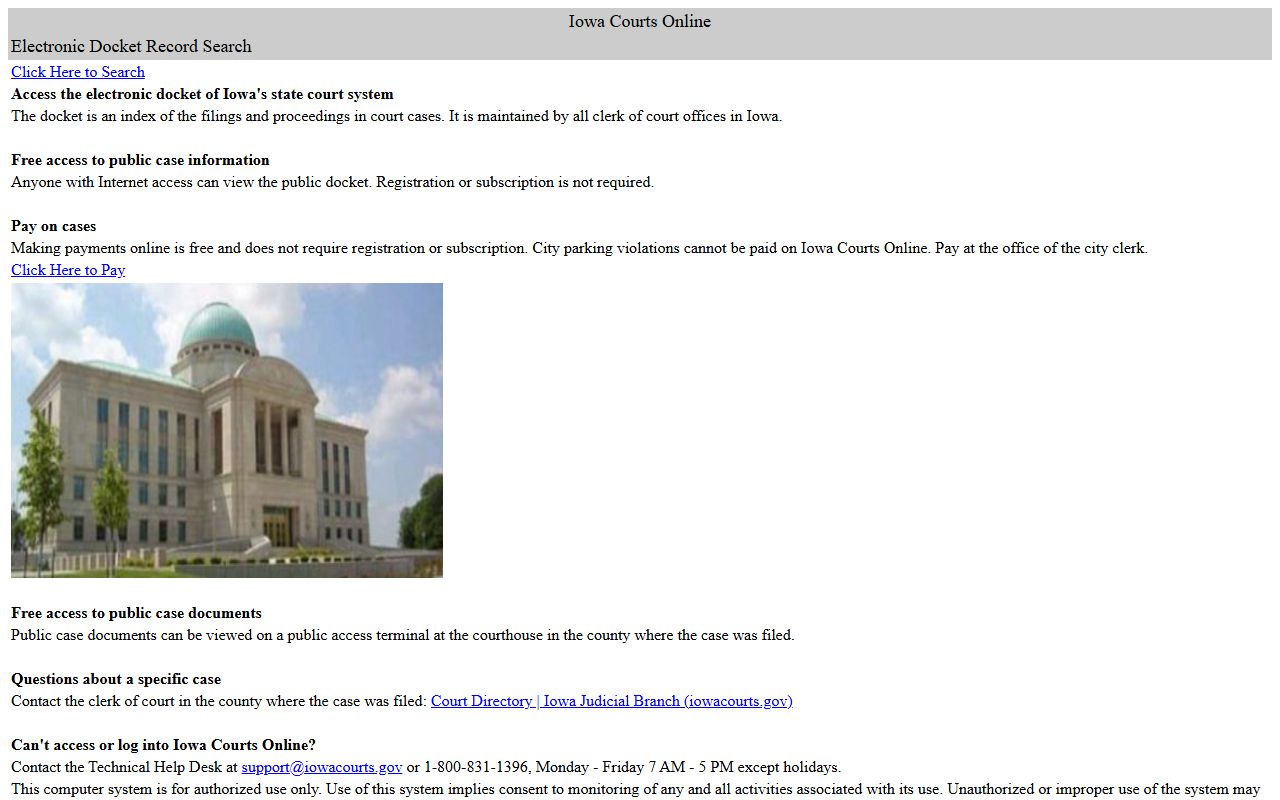
The court screen is the correct place to follow the filed case after the booking record has supplied the arrest-side details.
Johnson County Court Search Fields
The research pass captured the Iowa Courts Online landing and entry point, but the internal frame-based search fields were not fully captured. The official access rules are still clear. The public docket is free, online case payments do not require registration, and public case documents are available at courthouse public terminals in the county where the case was filed. For case-specific questions, the Iowa Courts Online landing page directs users to the clerk of court in the filing county.
| Access Point | Type | Use |
|---|---|---|
| Click Here to Search | Link/button | Enters the electronic docket search. |
| Public docket access | Online system | Free public index of filings and proceedings. |
| Public case documents | Courthouse terminal | View at a public access terminal in the county where the case was filed. |
| Help Desk | Email/phone support | support@iowacourts.gov or 1-800-831-1396 during posted weekday hours. |
Charges Filed After Arrest
Booking charges are not always the final filed charges. An officer may book a person on an arrest offense, then the County Attorney may file a formal charge that matches, modifies, adds to, or reduces the booking charge. Iowa criminal cases can involve a complaint, a prosecutor-filed trial information or information, or an indictment. The court docket is the stronger source for what is formally filed and how those charges later change.
| Document | What It Means | Why It Matters |
|---|---|---|
| Complaint | Initial charging paper or sworn allegation often tied to arrest or first appearance. | May be the first court-facing version of the arrest charge. |
| Information / Trial Information | Prosecutor-filed formal charge document in Iowa criminal practice. | Often controls the formal case charge after review. |
| Indictment | Grand-jury formal charge. | Less common than prosecutor-filed information but still a formal charge route. |
Charge Status After Johnson Arrest
Court records after a jail arrest should be read by charge, not only by case title. A roster charge can later be amended, reduced, dismissed, or replaced by a filed charge. A charge may also be pending even when the person has been released from jail. The Sheriff's Records Division records check does not provide disposition, so case outcome belongs in the court system.
| Status / Term | What It Means |
|---|---|
| Booking charge | Initial jail or arrest charge appearing on the roster. |
| Filed charge | Formal charge appearing in court after prosecutor or court action. |
| Amended charge | Charge changed after filing. |
| Dismissed charge | Charge no longer pursued, but public access may remain unless expungement or sealing applies. |
| Disposition | Court outcome; the Sheriff's jail records check does not include it. |
Bond and Release After Arrest
Johnson County roster detail pages can show bond by charge. In the inspected sample profile, fields included Bond Type/Sentenced and Bond Amount, with examples such as CASH/SURETY and NO INFO. The jail FAQ gives the live phone fallback: jail staff at 319-356-6025 can state whether a person is in custody, what charges the person is held on, what bond is required if applicable, and the scheduled release date if applicable. Jail staff cannot provide court information.
| Bond Type | How It Works |
|---|---|
| Cash bond | Money posted to secure appearance. |
| Surety bond | A surety route guarantees appearance; the Johnson County sample used CASH/SURETY. |
| Own recognizance | Release based on a promise to appear, often clearer in court records than jail roster fields. |
| No bond or hold | A court order, detainer, warrant, parole issue, or other charge may prevent release. |
Warrants and Court Arrest Records
No official Johnson County Sheriff active warrant search list was located in the research pass. The sheriff online resources page has a Most Wanted List and Alerts section, but it links to federal alert resources rather than a local Johnson County active warrant database. For a court-related bench warrant, Iowa Courts Online and the clerk are the better route. For custody after a warrant arrest, use the jail roster or call the jail information line.
- Arrest warrant
- A court order authorizing law enforcement to arrest a person.
- Bench warrant
- A warrant issued by a judge, often for failure to appear or violation of a court order.
- Detainer
- A hold or request from another agency that may affect release even when local bond appears.
Charges vs Convictions
An arrest and a charge are not the same as a conviction. Johnson County court records after a jail arrest may show accusations, amendments, hearings, releases, and final outcomes. A booking charge is a custody record. A conviction is a final court outcome after plea, verdict, or other disposition. That difference matters for employment, housing, licensing, and any formal background-screening process.
| Charge | Conviction | |
|---|---|---|
| Stage | Accusation or filed offense | Final finding or plea of guilt |
| Source | Jail roster and court docket may both list it | Court docket and official disposition records |
| Meaning | Not proof of guilt | Formal outcome unless later set aside or expunged |
Sealed and Expunged Records
Iowa Code Chapter 901C and section 901C.3 govern expungement categories identified in the research. The Johnson County Attorney page says expungement requests are processed by the Johnson County Clerk of Court after a completed form is filed, and the Attorney's Office receives notice and may respond. An expunged criminal case record is confidential and exempt from public access under Iowa Code 22.7. Eligibility depends on the case type and outcome, so the court process controls.
| Restricted / Sealed | Expunged | |
|---|---|---|
| Visibility | Limited from public view under a court rule or law. | Treated as confidential under applicable Iowa expungement law. |
| Who acts | Court or lawful custodian applies the restriction. | Clerk and court process after a proper filing. |
| Booking photo effect | Do not assume automatic removal from all cached sources. | Use official court and records-custodian channels for cleanup questions. |
Johnson County Attorney Records
Johnson County uses a County Attorney, not a district attorney. Rachel Zimmermann Smith is listed as Johnson County Attorney. The office address is 500 S. Clinton Street, Suite 400, Iowa City, IA 52244-2450. The phone number is 319-339-6100, and hours are Monday-Friday, 8:00 a.m.-5:00 p.m. The office prosecutes criminal violations for the State of Iowa and county ordinance cases, assists crime victims, handles forfeiture and fine recovery, and participates in juvenile and mental-health matters.
The County Attorney does not represent private people, defend private lawsuits, or provide private legal advice. The county's self-represented defendant notice says the County Attorney prosecutes criminal cases on behalf of the State of Iowa and cannot give legal advice to private parties. A defendant with pending charges should use a defense attorney for case questions.
Important: Use the jail for live custody and bond confirmation, Iowa Courts Online for dockets, and counsel for legal advice.